Back in 2002, I was at Camp Leakey helping coordinate the volunteers when we got word of an illegal gold-mining operation farther on the Sekonyer River. We organized a trip upriver to clear it out, with a few police officers coming along to handle the eviction. A couple of the camp assistants joined us, along with two or three volunteers and a student doing his own research.
We knew there were miners somewhere upriver, and that was about it. It was my first time helping evict illegal miners from Tanjung Puting National Park, but the trip didn’t seem unusual at first. We brought a few shovels, climbed into the speedboat and headed upstream.
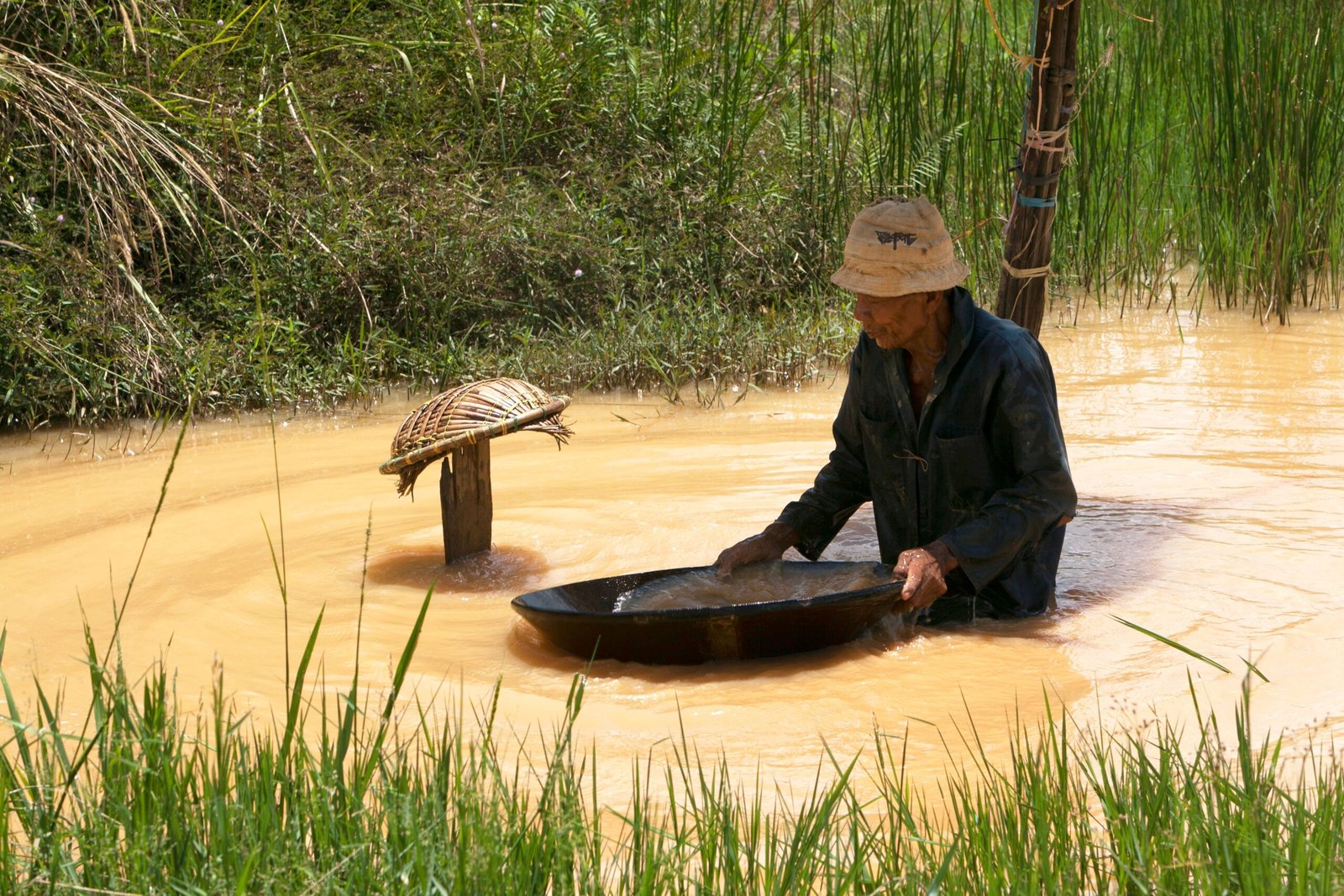
The operation we came across at first was small. There were a few rough huts, a large sluice used to separate gold from the mud, and trash scattered everywhere. Four people were mining for gold. One was a woman in a red floral dress of the sort you’d see in the shops around Pangkalan Bun. The others were men, all appearing to be in their forties.
They appeared to be a family or a small group of local people taking advantage of the lack of law enforcement to make some extra money. It did not look well funded or organized. I couldn’t imagine anyone choosing this kind of work if they had a better way to make a living.
The police were occupied at first, so we started cleaning up the trash around the site without them. The miners seemed interested in what was going on, not particularly worried. A group of foreigners had arrived and were now picking up garbage around their illegal gold-mining operation. We did not speak much to them. They mostly stood watching us work, probably wondering why we had come from another country to do this. Soon, a few of the police officers finished their task and rejoined us. We moved on to the next site, leaving a few officers behind to deal with the miners. And whatever became of them, I never saw.
Only a few metres away, hidden by the bushes, was something completely different. We did not see it until we were close to the edge.
The pit was enormous, a hole in the earth stripped down to raw clay and mud. I remember the edge of it more than anything. That instinctive feeling of oh my god before my brain caught up. It had the kind of scale you imagine the Grand Canyon having before you actually see it. It seemed completely out of place in what should have been forest inside a national park.
There were large hoses, heavy machinery, and an enormous amount of earth that had already been removed. This was not a few people trying to find a little gold beside the river.
This was an operation.
Nobody spoke. The shovels we had brought with us suddenly felt insignificant. It was clear we were not going to be filling in that pit anytime soon.
The police began rounding up this new group of miners. One of the miners was not happy about this and began to argue. It was the kind of arguing you’d expect when the police show up and start telling you your operation is over, even if your operation was an illegal one. After a while, several of us walked back towards the boat to get more supplies.
Then we heard a gunshot.
I looked at the others, trying to judge their reactions. Nobody looked particularly relaxed by this new turn of events. “Maybe they’re shooting the miners,” one of the assistants joked nervously. Two more shots. The joking stopped.
I ran towards the sounds. Sephon, one of the assistants, yelled at another assistant to give him a shovel.
Sephon ran alongside me. The shots had come from less than fifty metres away, somewhere behind the bushes. Almost immediately, we came across one of the miners.
He did not seem worried at all. His calm demeanor relaxed us a bit.
A short distance on, we found two of the police officers standing near the mining equipment with their guns drawn. The police officers had been firing at the mining machinery.
Nobody had been shot, despite my fears. The miners were not attacking us. Sephon finally relaxed completely and put down his shovel.
The miners felt they were being treated unfairly and were reluctant to cooperate. The police had responded with a show of force. Needless to say, this was not a situation I had experienced with police in Canada, who might have had a difficult time explaining in a report why they had fired several rounds into some mining equipment.
The tension soon passed, and things returned to relative normality. The student working with us was wearing nothing but his underwear. At some point, he had apparently decided that pants and a T-shirt were no longer necessary. I couldn’t really blame him. It was extremely hot, with no shade from the tropical sun, and the mud was ankle-deep. One misstep could mean spending the next several hours walking around in mud-soaked clothes. The logic of it made sense; the optics didn’t.
I suggested he put his pants back on. He didn’t. He stood there in his white briefs, barking instructions at the miners. Fully dressed, armed police officers stood a few feet away.
After another hour, the light began to fade. The miners had finished packing their equipment and were being escorted out of the park by the police. We headed back down river to camp and ate our dinner.
There were other incidents during my time in Tanjung Puting, but few stayed with me quite like this one. Illegal mining was not just a few unorganized people trying to make some extra money to get by. The real danger and the biggest impact was usually hidden a few metres away, operating on an entirely different scale and with a much bigger budget.
You could remove the miners. You could shoot their machinery. You could clean up some of their trash. But you could not undo that damage with a few shovels.