There were a number of things we learned fairly quickly about working in the jungle. Studying wild orangutans involved quietly walking the trails, listening for the telltale sounds of them moving through the trees or the "plop, plop" of fruit hitting the ground as they ate. Over time we’d built a trail system that spanned a total area of 35 square kilometres.
Once we found an orangutan, we followed it until it built a nest, or sleeping platform, for the night. Orangutans usually build a fresh nest every evening.
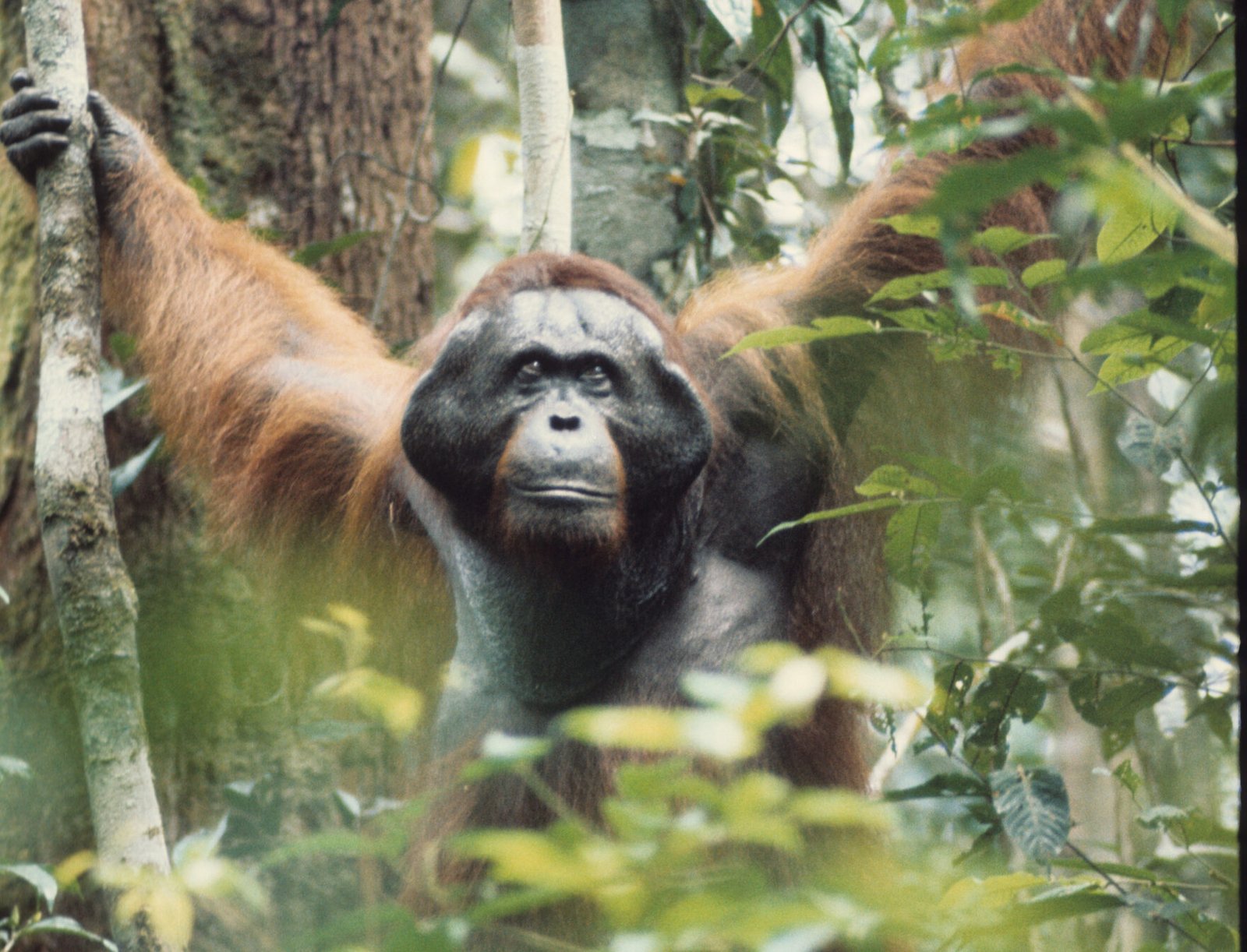
On this particular day, we were out cutting trails when we came across a wild male orangutan. Finding an orangutan took priority, so we put down our trail-cutting work and followed him. As the afternoon wore on, he showed no interest in building a nest. This was unusual. Orangutans normally begin building their nests about an hour before sunset. On this day, he waited until the last moments of daylight before settling down.
We needed to find him again at dawn, so we started marking a faint trail from beneath his nest back toward the nearest grid trail. That was when it dawned on us that we had gone out to cut trails that day and hadn’t intended to follow an orangutan this far in the forest. By the time we’d finished, it was almost completely dark.
“Did you bring a flashlight?”
“No.”
Sunset in the tropics is not a gradual fading of light. It’s more like someone flipped off the lights.
We were on the grid trail, so we reasoned that by walking one behind the other, we could follow it for the 1.5 km back to the open field. From there, we should have had an easy time getting home. This was a tall order, but our only option.
We listened for the “crunch, crunch” of dried leaves, which would tell us we had stepped off the well-worn trail. We hadn’t gone far when the crunching grew louder. We were pushing through leaves and undergrowth. We were off the trail.
In daylight, finding the trail again would have taken a few minutes at most. In complete darkness, we couldn’t see the ground in front of our feet. And even if we found it, there were still two more intersections before we got to the field. The grid trail was no wider than my shoulders. How would we be able to detect the intersection where we needed to turn right?
Continuing to search risked leaving us even less certain of where we were. Fire ants alone were reason enough not to wander aimlessly in the dark. Running into a nest of them meant a sudden sprint through the jungle, accompanied by lots of cursing. So we did the only thing we could think of doing. Nothing.
The ground was wet, and there were leeches, so sitting down wasn’t an option. We stood there swatting unseen mosquitoes whenever we felt them bite. We spent a while considering our options and concluded that there weren’t any, other than waiting until morning.
This was going to be a long night.
A few hours passed.
We could hear insects and occasional rustling through the leaves.
A few more hours passed.
We discussed improvements to our flashlight policy.
Then a faint call came through the jungle. At first, it was hard to tell if it was a person or a bird.
We listened intently. Amat and his wife were the only other people at camp. We usually returned just before or slightly after sunset so we hoped Amat might have noticed we hadn’t returned.
We called back with three short howls, our code for “OK,” every few minutes, hoping he would hear us. Finally, a faint reply came. It was then that we knew we might not have to spend the whole night in the jungle. We had established contact, but the grid trails were hundreds of metres apart. To reach us, Amat would probably have to walk away from our voices before finding a trail leading in our direction. We feared we might lose contact again.
We kept calling back and forth to pinpoint our positions. Gradually, the calls became louder. In the darkness, it was impossible to tell exactly where he was coming from, but he was getting closer. It went on for nearly an hour before we saw the beam of a flashlight through the trees. Amat appeared behind it.
It took another hour to walk back to camp. We were home well past midnight, covered in mosquito bites. Our first action was to put flashlights in our bags. Then we ate dinner.