One small population, recognized as a species in 2017.
The Tapanuli orangutan (Pongo tapanuliensis) lives only in the Batang Toru landscape of North Sumatra. It is one of three living orangutan species and has the smallest wild population of any living great ape species.
A range-wide survey carried out from 2021 to 2023 estimated 716 Tapanuli orangutans (95% confidence interval: 645–792) across three meta-populations. That estimate is a survey baseline, not a current headcount, and the researchers concluded that a population this small has almost no buffer against additional mortality.
Tapanuli Orangutan Range
The species is now restricted to the Batang Toru Ecosystem in North Sumatra, where its surviving range covers roughly 1,000 square kilometres across a small number of forest blocks. Its historical range was much larger and included lower-elevation habitats. Tapanuli orangutans are not mountain specialists; the hill and submontane forests where most survive today are what remains of a formerly broader range.
How Tapanuli and Sumatran orangutans differ.
The differences are subtle. Tapanuli orangutans look more like Sumatran orangutans than Bornean orangutans, and appearance alone is not a reliable way to identify every individual.
Tapanuli
Pongo tapanuliensis
- Linear build and cinnamon-coloured coat
- Shorter, noticeably frizzier body hair
- Prominent moustache in mature males
- Flat flanges covered with downy hair in dominant males
- Females can have visible beards
Sumatran
Pongo abelii
- Similarly slim, linear build
- Longer, looser body hair
- Often pale orange to cinnamon in colour
- Different cranial and dental proportions
- Wild range lies mainly north of Lake Toba
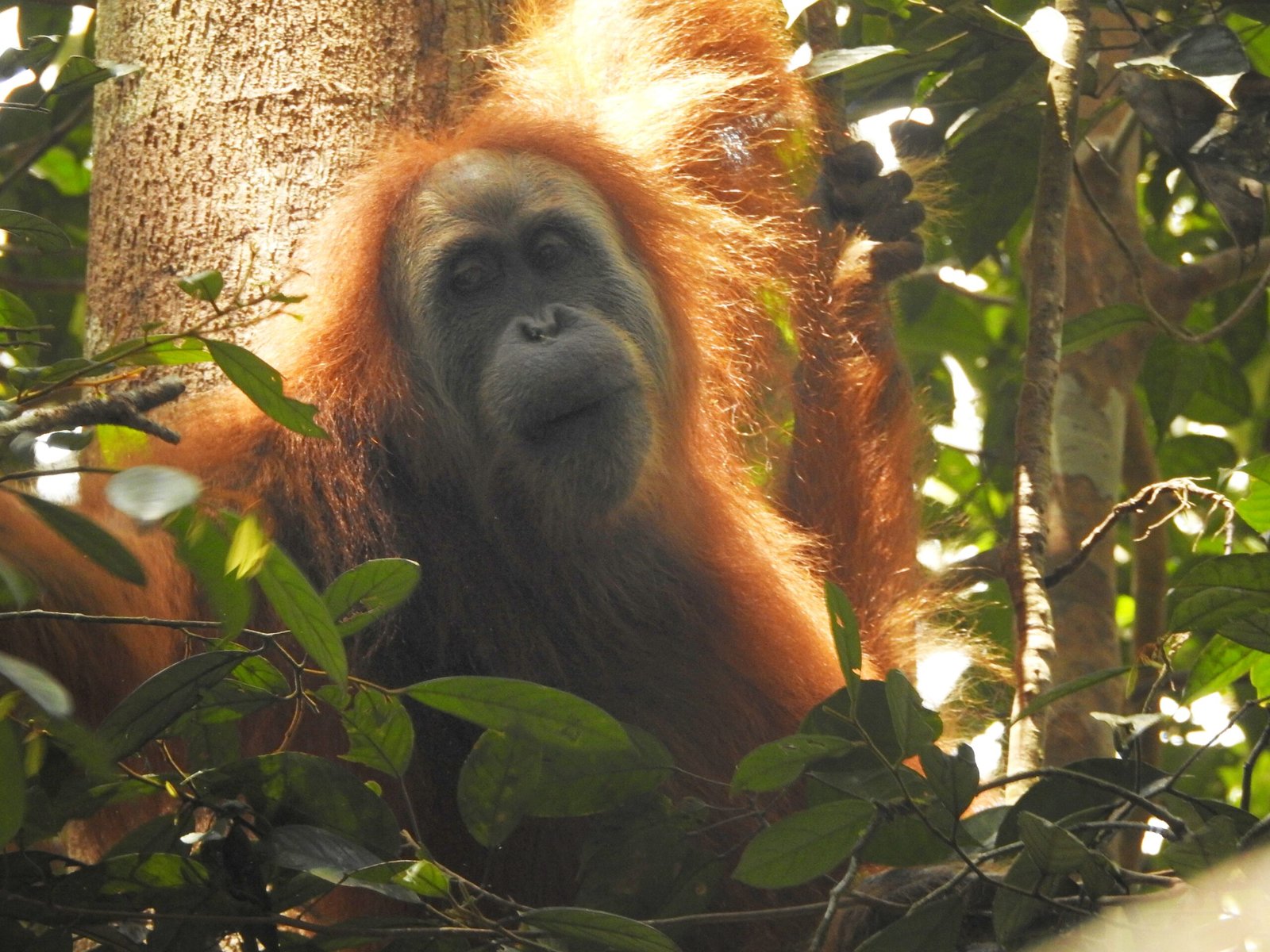 Tapanuli
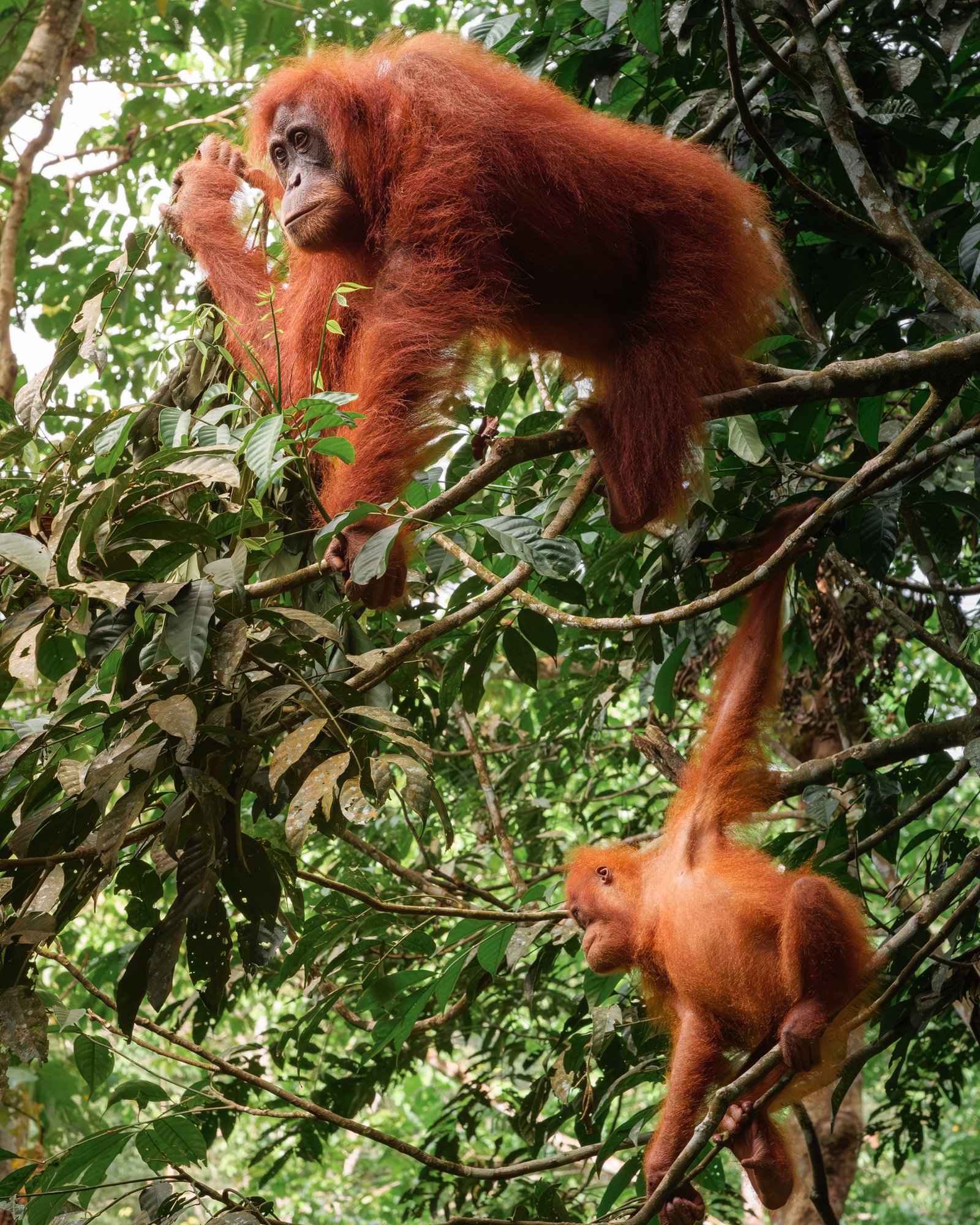 Sumatran
-
Hair. Tapanuli orangutans tend to have shorter, frizzier body hair; Sumatran orangutans generally have longer, looser hair.
-
Male face. Mature Tapanuli males can show a particularly prominent moustache and flatter cheek pads covered with fine hair.
-
Build. Both are relatively slim compared with Bornean orangutans, so overall body shape is a weak field mark between these two species.
-
Identification. The visible differences overlap. Genetics and cranial and dental morphology provide stronger evidence for separating the species than appearance alone.
A population that turned out to be a separate species.
The orangutans of Batang Toru had been known for years, but a 2017 study combined skull and dental measurements, behaviour and genomic evidence to show that the population was distinct enough to be described as a third living orangutan species.
Genomic analysis in that study found that the deepest split among living orangutan lineages separates the Batang Toru population from orangutans north of Lake Toba. The species was named Pongo tapanuliensis after the Tapanuli region where it survives.
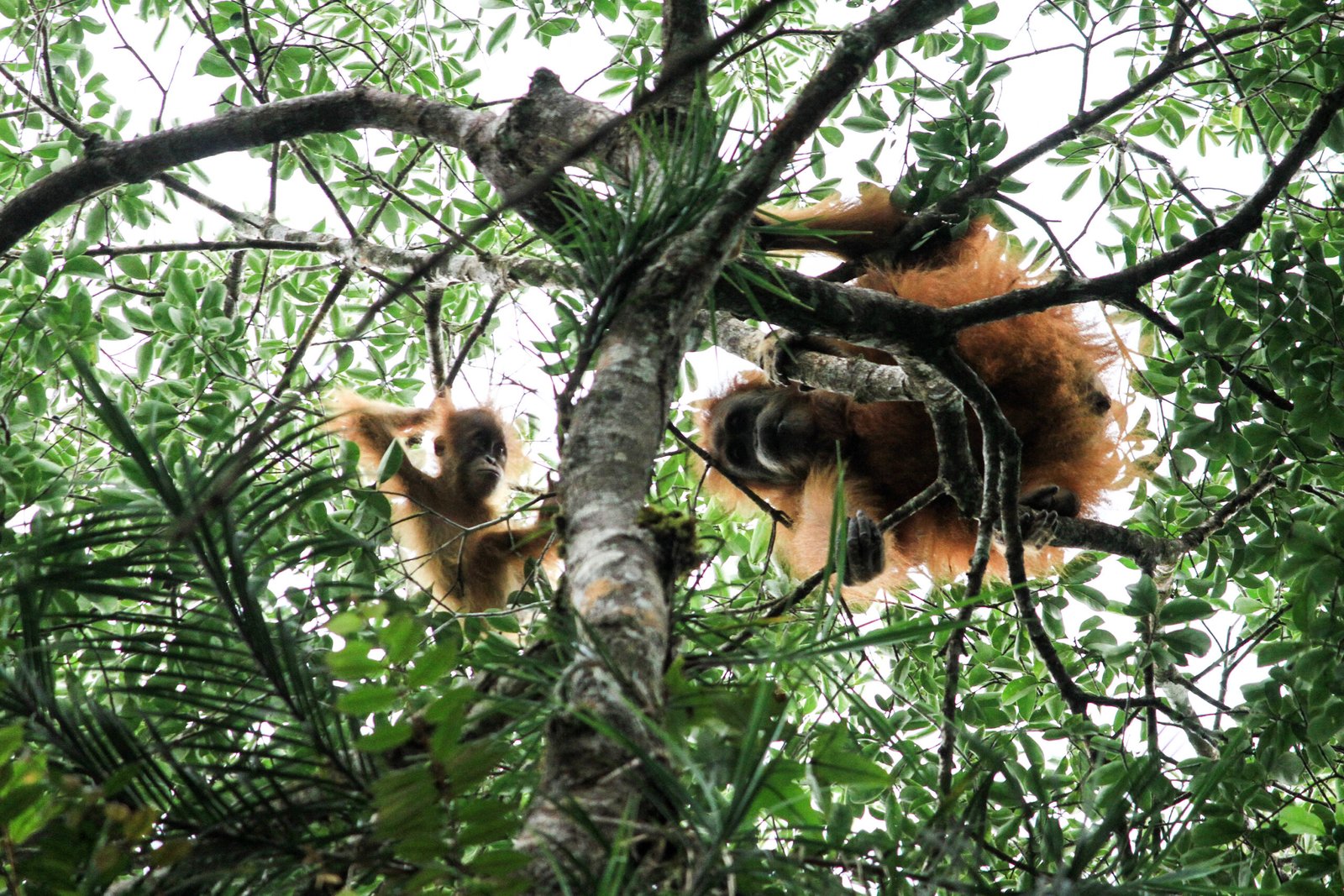
A great ape confined to a small mountain landscape.
Most of the known Tapanuli orangutan range lies in hill and submontane forest roughly 300 to 1,300 metres above sea level. Densities are highest in primary forest, although orangutans also use some mixed agroforest along forest edges at lower densities.
Their small range makes connectivity unusually important. Roads, cleared land and other breaks in the canopy can isolate groups that already have very little demographic room for additional losses.
Critically Endangered
With a 2021–2023 estimate of 716 individuals (95% CI: 645–792), every additional loss matters. Protecting the remaining Batang Toru forests and maintaining connections between population blocks are central conservation priorities.
Habitat loss and fragmentation come from several directions. Recent research identifies smallholder agriculture and small-scale logging as major drivers of forest loss, while mining, geothermal development, hydropower and other infrastructure add further pressure in parts of the landscape.
Go deeper.
Read the population research behind the current estimate, the paper that described the species, and the companion OCI species pages.