The Illegal Trade in Orangutans
International trafficking gets much of the media attention, but most documented orangutan crime happens within Indonesia. Orangutans are killed, captured, kept illegally as pets, or sold, often without ever leaving the region where they were captured.
The true scale of orangutan crime is considerably larger than official figures suggest. Many killings go unreported, and even when they are documented, few cases lead to prosecution.
How Orangutans Often Enter Illegal Captivity
Infant orangutans are captured from the wild to supply the illegal pet trade. Because infants depend on their mothers, capturing one nearly always involves killing the mother. The capture of a single infant can therefore mean the loss of two orangutans from the wild.
Forest Is Opened
Clearing, roads, plantations, mines and settlements bring people deeper into orangutan habitat.
Conflict Follows
Displaced orangutans may enter farms or plantations while searching for food and can be treated as pests.
A Young Orangutan Is Taken
Surviving infants are taken from the forest and may be kept as pets or passed into the illegal wildlife trade.
Possession or Trade Follows
The animal may be kept privately, passed to another person, offered for sale or moved through a wider trafficking network.
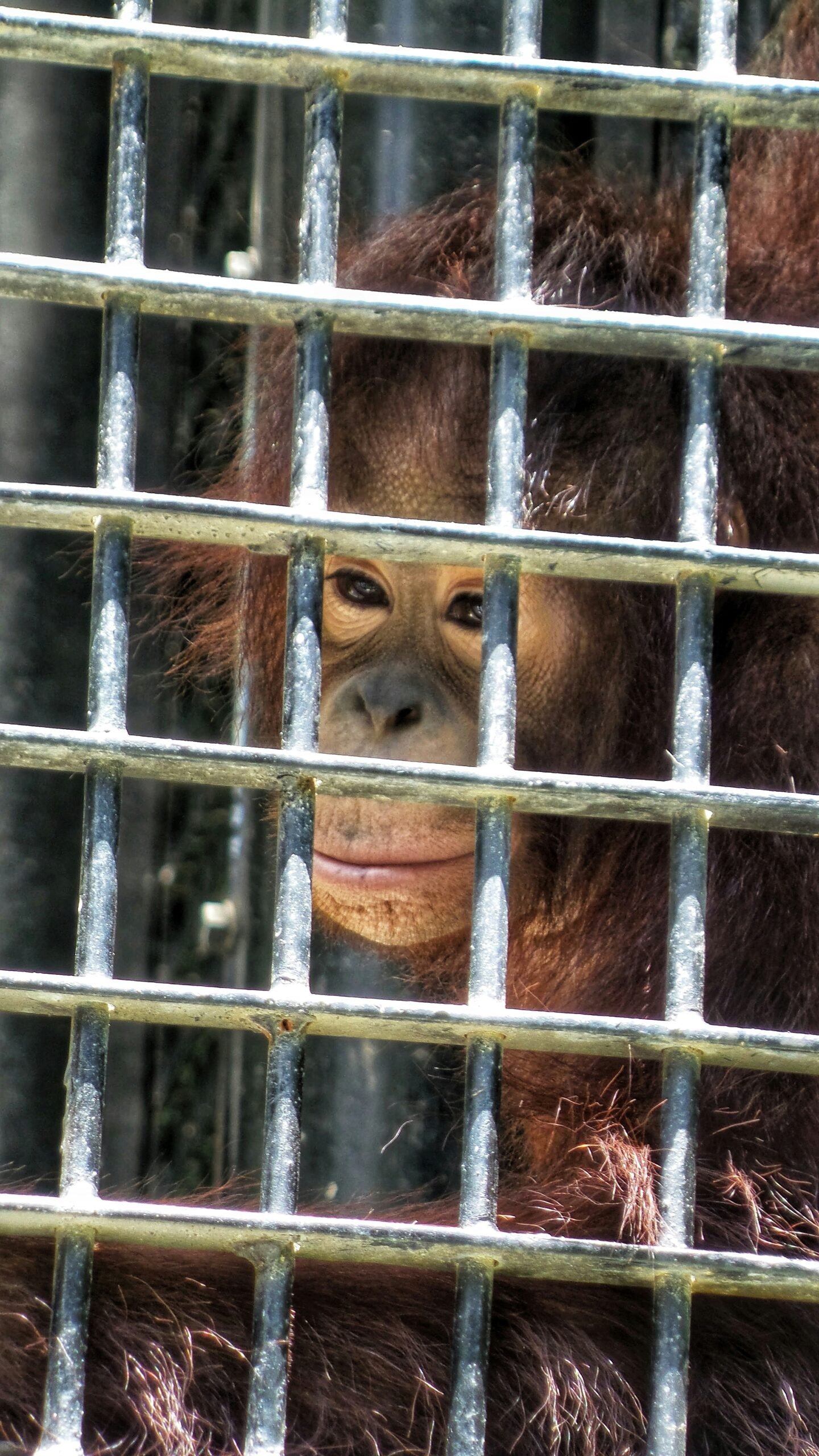
Of 2,229 reported orangutan crimes from 2007 to 2019, only 22 could be linked to court cases.
Of those, twenty cases resulted in convictions involving 31 people. The gap reveals more than limited prosecution. Investigations rarely established how illegally held infant orangutans entered captivity. Recovering an orangutan usually does not mean identifying or prosecuting those responsible for its capture.
- Killing accounted for roughly half of reported Bornean orangutan crimes and 43% of Sumatran and Tapanuli crimes combined.
- The origins of illegally held infants, including whether their mothers had been killed, were rarely investigated.
Why Official Figures Underestimate Orangutan Killings
Most orangutan killings are never reported or detected. With wildlife-crime detection estimated at below 10%, official records can reveal only a small part of the problem.
Accounting for killings missed by official records produces a modeled loss equivalent to 14.3% of the Sumatran and Tapanuli orangutan population over 2014–2016.
Spread across three years, that estimate works out to roughly 4.8% per year, more than twice the 2% annual hunting mortality rate that population models show can drive orangutans toward extinction. This is a rough comparison of modeled rates, not a measured annual death rate.

Too Few Officers, Too Little Enforcement
Protecting orangutans requires more than laws on paper. Across national parks with orangutans in Sumatra and Indonesian Borneo, enforcement staffing was estimated at just 0.28–2.11 officers per 100 km², well below the global recommended range of 3–11. With so few officers covering vast areas of forest, detecting crimes, investigating complaints and bringing offenders to justice becomes considerably more difficult.
Education campaigns and the voluntary surrender of illegally held orangutans have an important role, but they have not been accompanied by a decline in reported crimes. Without stronger patrols, investigations and prosecutions, there is little reason for offenders to expect consequences. Effective protection also depends on working with local communities to address the pressures behind these crimes.
Where Orangutan Crime Occurs
Taken from the forest
Local / internal crime
95.7–99.6%of reported crimes involved local rather than international trade
International trafficking
0.5–4.3%Of reported crimes, this share was definitively linked to international trade.
What Recent Orangutan Trafficking Cases Show
Reported crime in the 2007–2019 dataset was overwhelmingly local, but recent cases show active cross-border routes, online markets and trade in wildlife parts.
Apes advertised online
Orangutans and other apes have also been advertised for sale through Indonesian social-media accounts. A review published in 2021 recorded:
Cross-border trafficking routes remain active
In January 2026, authorities intercepted a vehicle in East Aceh carrying a Sumatran orangutan and other protected wildlife intended for smuggling to Thailand. In June, the driver was sentenced to three years in prison. The case followed Indonesia’s December 2025 repatriation of four orangutans trafficked to Thailand.
The trade is not limited to living orangutans
In 2025, Indonesian authorities disrupted an alleged online export operation involving 94 protected-wildlife specimens, including 70 primate skulls from orangutans, macaques and monkeys. In 2026, a separate U.S. case documented adult and infant orangutan skulls trafficked from Indonesia.

What Happens After an Orangutan Is Confiscated
Rescue is only the beginning of a rehabilitation process that can take seven years or longer.
In the wild, young orangutans remain with their mothers for roughly seven to eight years, learning which foods to eat, how to navigate the forest canopy and how to build nests. Orphans must learn these same skills in rehabilitation centres, often through years of supervised forest school.
Before an orangutan can be released, it must demonstrate that it can survive independently. Some never reach that stage. Illness, injury or prolonged captivity may mean they require lifelong care.
Confiscation should also trigger an investigation into how the orangutan entered captivity. Authorities can document where the animal was found and trace how it was obtained.
Preventing the Next Crime
Respond to the individual animal
- Confiscate illegally held orangutans
- Provide veterinary care and quarantine
- Rehabilitate animals that may be releasable
- Preserve evidence and investigate how the animal was obtained
Reduce opportunity and increase consequence
- Protect habitat and reduce conflict around farms and plantations
- Increase patrols and investigations in high-risk landscapes
- Follow evidence through to arrests and prosecution where cases support it
- Build community-focused solutions with people living beside orangutan range
See how illegal trade connects to habitat loss, fire and conflict.
Orangutan crime often begins before an animal is ever offered for sale. Forest disturbance can increase contact with people, conflict and the risk of killing or capture.
Research and Sources
The crime statistics on this page describe reported crimes and enforcement records, not a count of individual orangutans. One animal can be associated with more than one offense, and many wildlife crimes are never detected. The 22 court cases were linked to the 2,229 reported crimes; 20 resulted in convictions.
Mortality methodology and data limitations
Sherman et al. applied published wildlife-crime detection rates to reported killing records and estimated orangutan populations. The paper’s abstract reports average estimated species mortality of 14.3% for Sumatran and Tapanuli orangutans combined and 5.1% for Bornean orangutans at expected detection rates below 10%. In the results section, the 2017–2019 Bornean estimate is 6.3%; Table 2 uses 2014–2016 for Sumatra because comparable population estimates for other periods were unavailable.
These are modeled multi-year estimates, not observed annual mortality rates. The main text divides the 14.3% Sumatran and Tapanuli estimate across the 2014–2016 study period to illustrate a rough annual equivalent of 4.8%, assuming losses are spread evenly. The 2% annual hunting threshold comes from separate orangutan population models and is an indicative comparison, not a directly measured equivalence. The 5.1% Bornean figure covers multiple study periods and should not be annualized as a single three-year estimate. International-trade figures include only cases definitively linked to cross-border trafficking, not undetected movements.
Research studies (4)
- Biological Conservation: Orangutan killing and trade in Indonesia
- American Journal of Primatology: Orangutan trade, confiscations and prosecutions
- Diversity: Advertising and sale of apes on Facebook and Instagram in Indonesia
- Frontiers in Conservation Science: Global primate trade and trafficking review
Enforcement reports and legal sources (7)
- CITES Appendices: orangutans are listed in Appendix I
- Indonesia: Law No. 32 of 2024 amending the national conservation law
- Indonesia Ministry of Forestry: 2026 orangutan trafficking case in East Aceh
- Mongabay: 2026 conviction in East Aceh wildlife-smuggling case
- Indonesia Ministry of Forestry: 2025 online wildlife-parts trafficking case
- Indonesia Ministry of Forestry: 2025 orangutan repatriation from Thailand
- U.S. Fish & Wildlife Service: 2026 orangutan-skull trafficking case