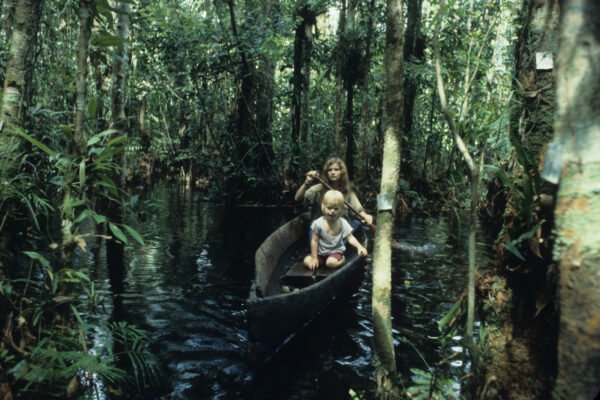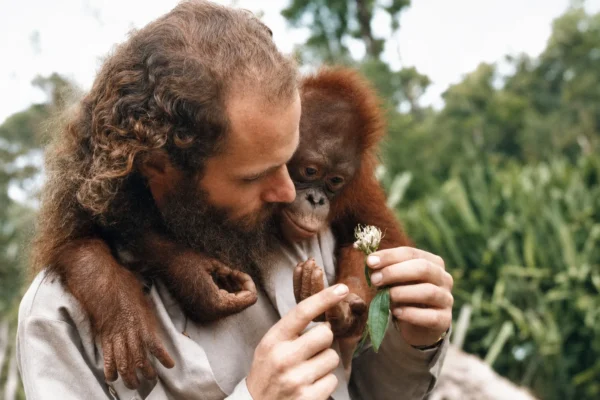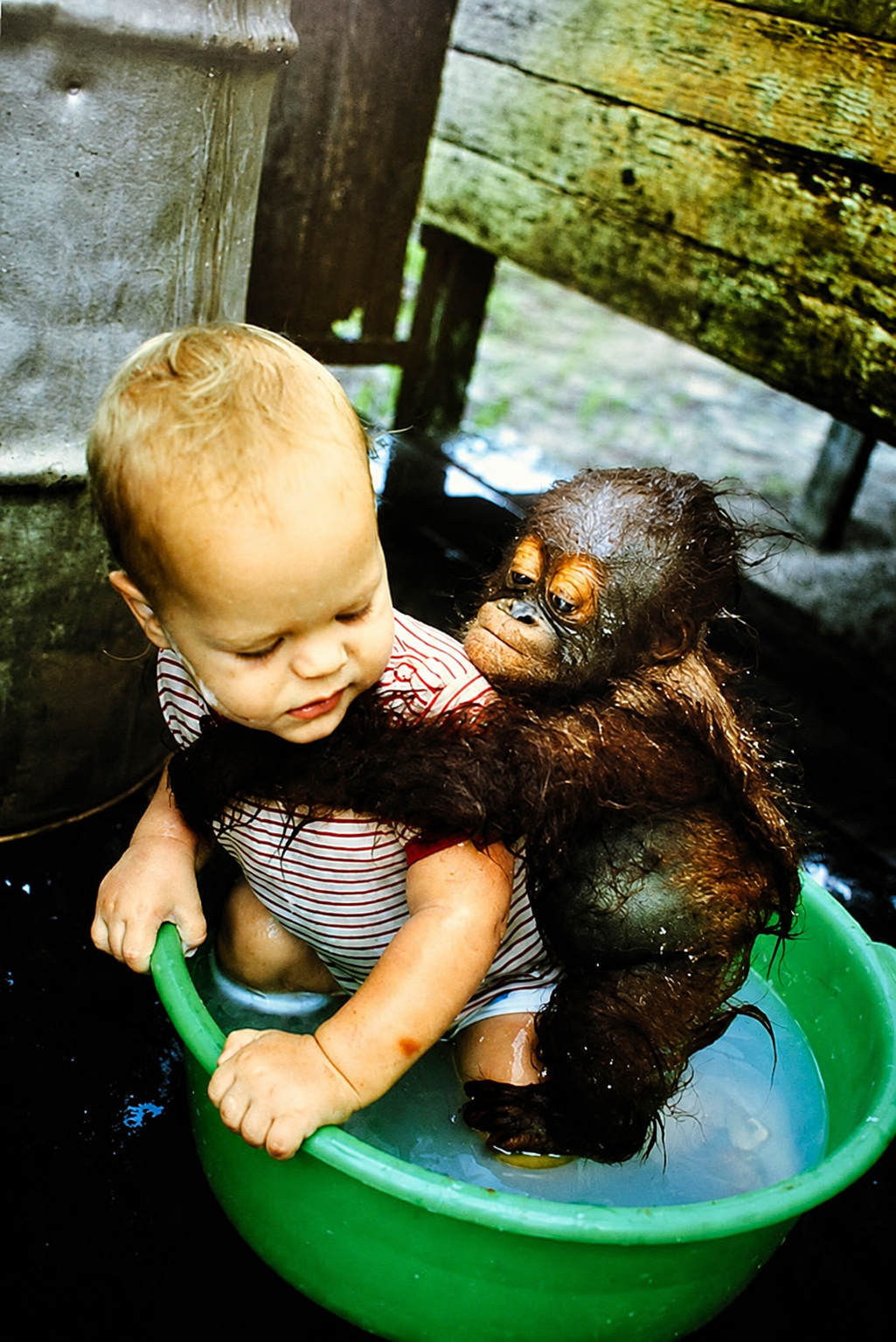
I was born in Indonesia in 1976. My parents were Biruté Galdikas and Rod Brindamour, the founders of Camp Leakey, the research station in what is now Tanjung Puting National Park.
I knew about the National Geographic cover featuring Princess and me. People brought it up occasionally throughout my childhood. They still do.
I spent the first few years of my life at Camp Leakey, although I don’t remember much from that time. I really only have one clear memory: a hole at the end of a jetty that I would jump over. I remember looking at it and thinking, What will happen if I miss? Then, on the next jump, I went through the hole and into the river. My parents remember what happened next better than I do. One of my mom’s students jumped into the water and pulled me out. That is basically my only memory from my first three years at Camp Leakey.
Most of my memories come from the years that followed. From about the age of five until I was thirteen, I returned every year or two to visit my mom. Over those years, I watched Camp Leakey slowly evolve.
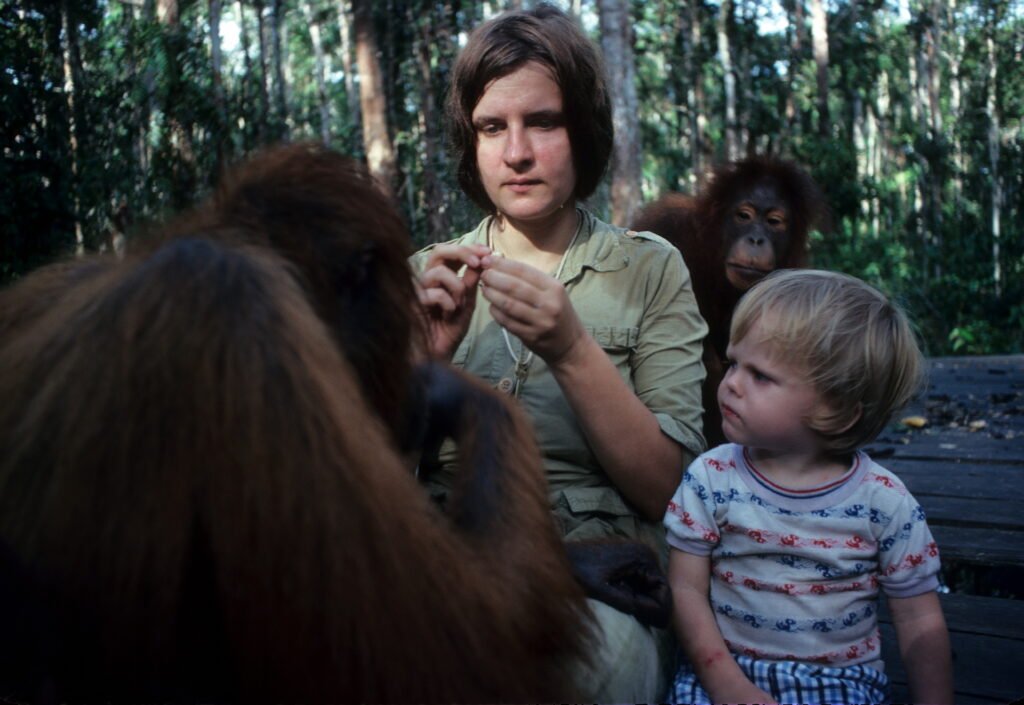
For most of my time there, Camp Leakey remained a fairly small research camp. Only a few klotoks (wooden boats with upper decks and living areas) arrived each week, carrying small groups of visitors. Everyone who lived there long term was an assistant, there to help with the research and the orangutans. It felt remote, and it was remote.
There was no electricity at Camp Leakey. At night, we used candles and carried flashlights between the buildings. There were no streetlights, nothing casting a glow in the distance, no cars humming somewhere nearby and no strangers passing on a sidewalk. Every star in the sky was visible, and counting shooting stars could pass for entertainment. The nights were quiet. Apart from the cicadas, there was little to hear.
The closest village was seven hours away by klotok. You become acutely aware of how much you rely on other people when you go long periods without seeing anyone outside the camp. At some point during those years, Camp Leakey acquired a speedboat, but it was only for emergencies. Unfortunately, emergencies did not always occur when the speedboat was working.
That same distance shaped what we ate. We ate fresh vegetables in the first few days after the supply boat arrived. After that, we ate sardines, corned beef and rice. Once, when the supplies ran especially low, the cook resorted to catching bugs for dinner.
The orangutans were always there, familiar faces on your way to the dining hall. I remember one macaque that presented a different problem. When I was about ten, it would attack me on sight. If I had food, I was guaranteed to lose it. That macaque had become my schoolyard bully.
There was also a baby sun bear that followed me around and occasionally bit me. It was only playing. The macaque, however, was out for my blood.
By the time I was 11 or so, Camp Leakey had started to receive more visitors. Earthwatch teams came for a few weeks at a time. It was still remote, but it didn’t feel quite as empty.
At night, you kept the flashlight pointed at the path to avoid stepping on a cobra or scorpion, and it came with you to the outhouse too. Every time I went, I checked for large spiders first. The smaller ones were fine, but spiders the size of my hand were not. If one was inside, I usually found another outhouse. Once, I stayed and kept my flashlight on it the entire time, watching to make sure it did not move any closer to me. Their eyes would flicker like glass when they caught the flashlight’s beam.