One species, three recognized subspecies.
The Bornean orangutan (Pongo pygmaeus) lives nowhere else. Across Borneo, three recognized subspecies occupy different parts of the island, their ranges shaped by geography and increasingly fragmented by forest loss.
The Bornean species accounts for the great majority of orangutans estimated to remain in the wild. Its large range and relatively high numbers compared with the Sumatran and Tapanuli species can make it seem more secure, but those orangutans are spread across a vast and increasingly divided landscape.
Explore Bornean Orangutan Ranges
Borneo's three recognized subspecies are the Northwest Bornean orangutan (Pongo pygmaeus pygmaeus), Central Bornean orangutan (Pongo pygmaeus wurmbii) and Northeast Bornean orangutan (Pongo pygmaeus morio). Select a range to see where each occurs and how Tanjung Puting fits within the Central Bornean range.
How can you tell them apart?
The differences are tendencies rather than absolute rules, but the two species often have noticeably different builds, faces and coats.
Bornean
Pongo pygmaeus
- Generally stockier build
- Broader face
- Darker, coarser reddish hair
- Large rounded cheek pads in mature flanged males
- More likely to travel on the ground
Sumatran
Pongo abelii
- Generally slimmer build
- Longer, narrower face
- Longer and often paler orange hair
- Narrower cheek pads and more facial hair in mature males
- More consistently arboreal
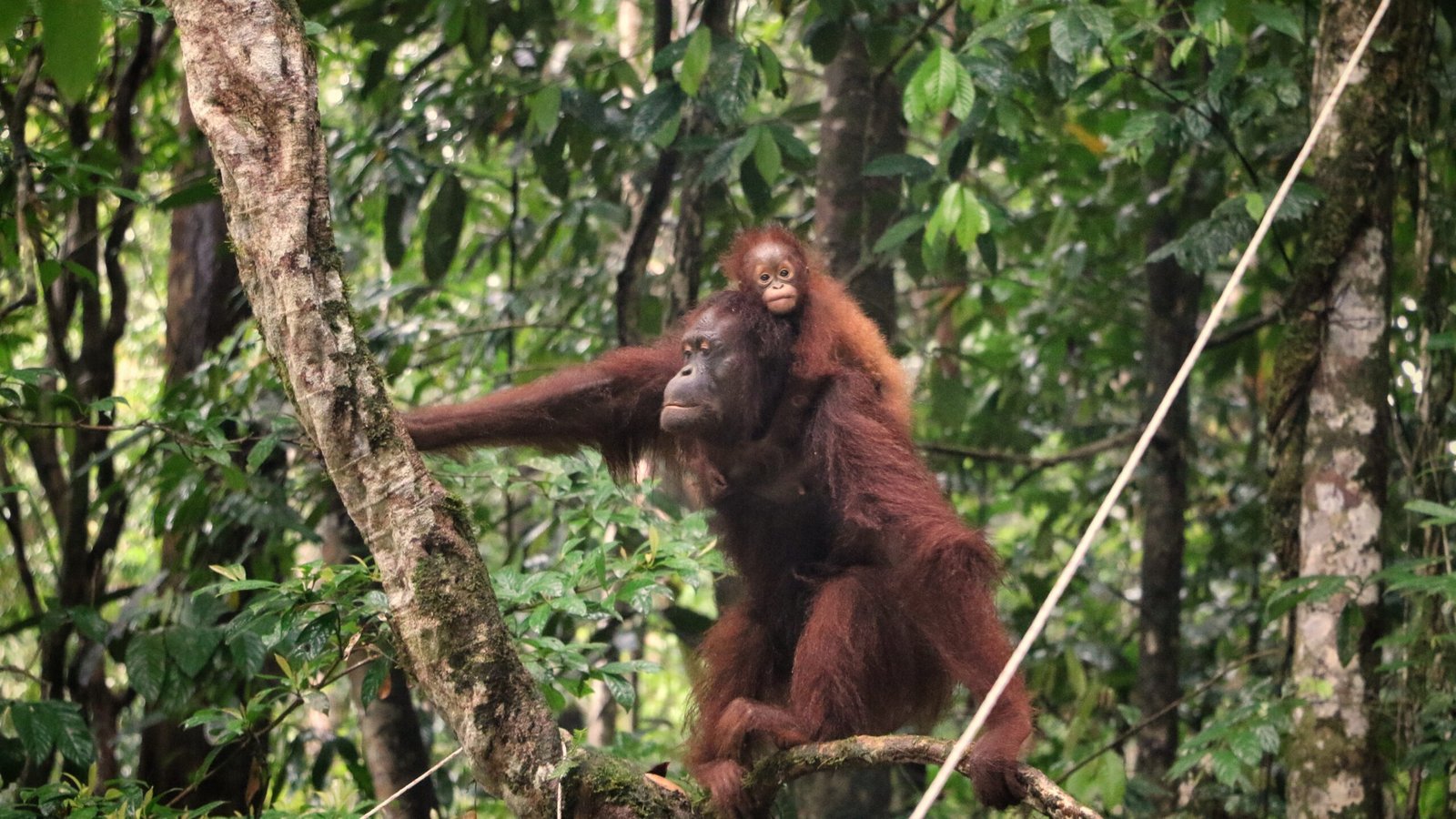 Bornean
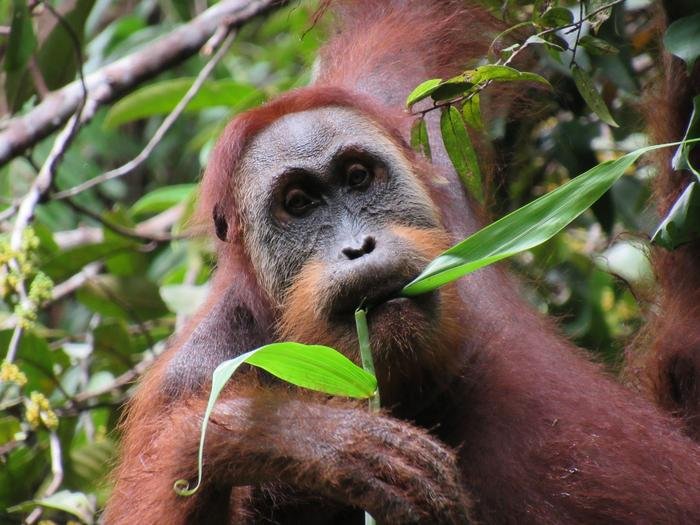 Sumatran
-
Face. Bornean orangutans tend to have broader faces; Sumatrans are generally longer and narrower.
-
Hair. Borneans are usually darker and coarser; Sumatrans often have longer, paler hair.
-
Build. Borneans tend to be stockier, while Sumatrans are generally slimmer.
-
Adult males. Borneans often develop larger rounded cheek pads; Sumatrans tend to have narrower pads and more facial hair.
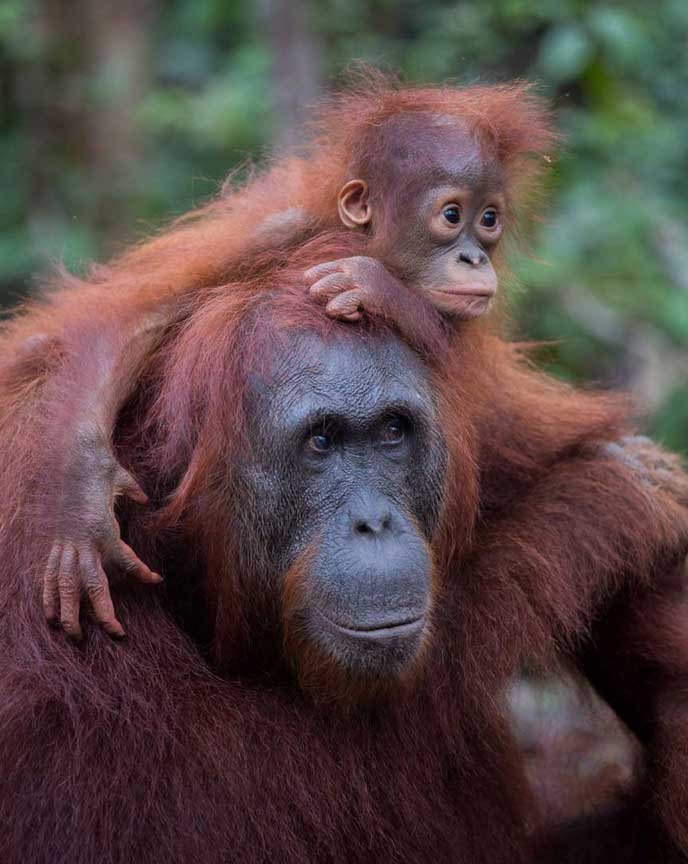
Adapted to many kinds of rainforest.
Bornean orangutans live in several forest types, including lowland rainforest, hill forest, peat swamp forest and freshwater swamp forest. Across these habitats, they depend on suitable forest and connected canopy for food, shelter and movement.
- Canopy life. Long arms, mobile shoulders and grasping hands and feet make movement through trees highly efficient.
- Flexible movement. They spend most of their lives above the ground, but Bornean orangutans use the forest floor more often than Sumatran orangutans.
- Flexible diet. Fruit is important when available, while leaves, bark, flowers, insects and other foods can become more important when fruit is scarce.
- Long childhood. Young orangutans spend years learning and feeding alongside their mothers; long maternal care and slow reproduction mean depleted populations cannot rebound quickly.
Critically Endangered
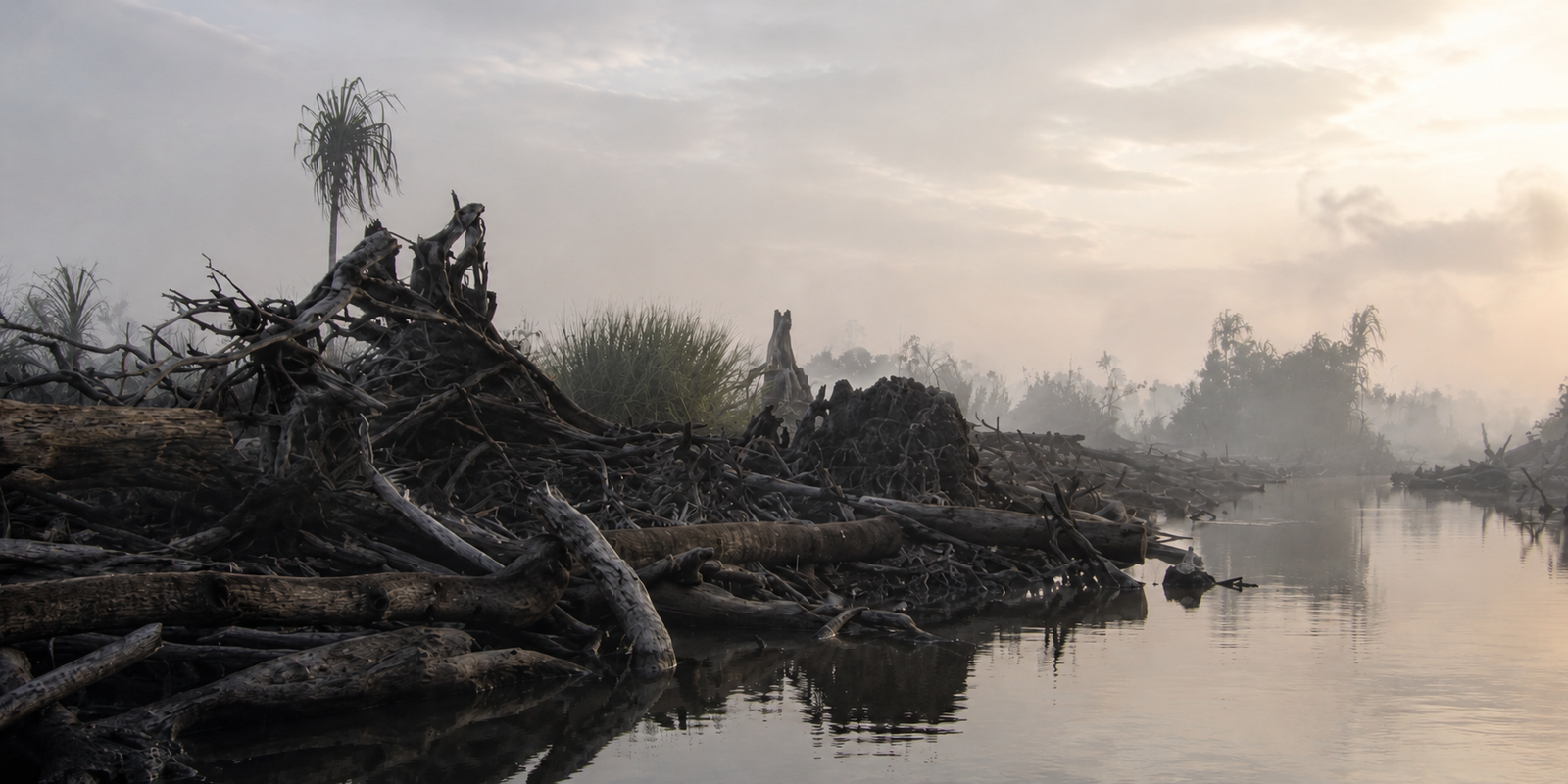
The Bornean orangutan is Critically Endangered. Its decline is driven largely by the loss and fragmentation of forest across Borneo, leaving many populations in smaller and increasingly isolated areas.
Across Borneo, forests are still being cleared or broken up for agriculture, including oil-palm development, logging, roads and other development. Fires can destroy even more habitat. Orangutans are also killed, captured or pushed into conflict with people, losses that are especially hard to replace because they reproduce so slowly.
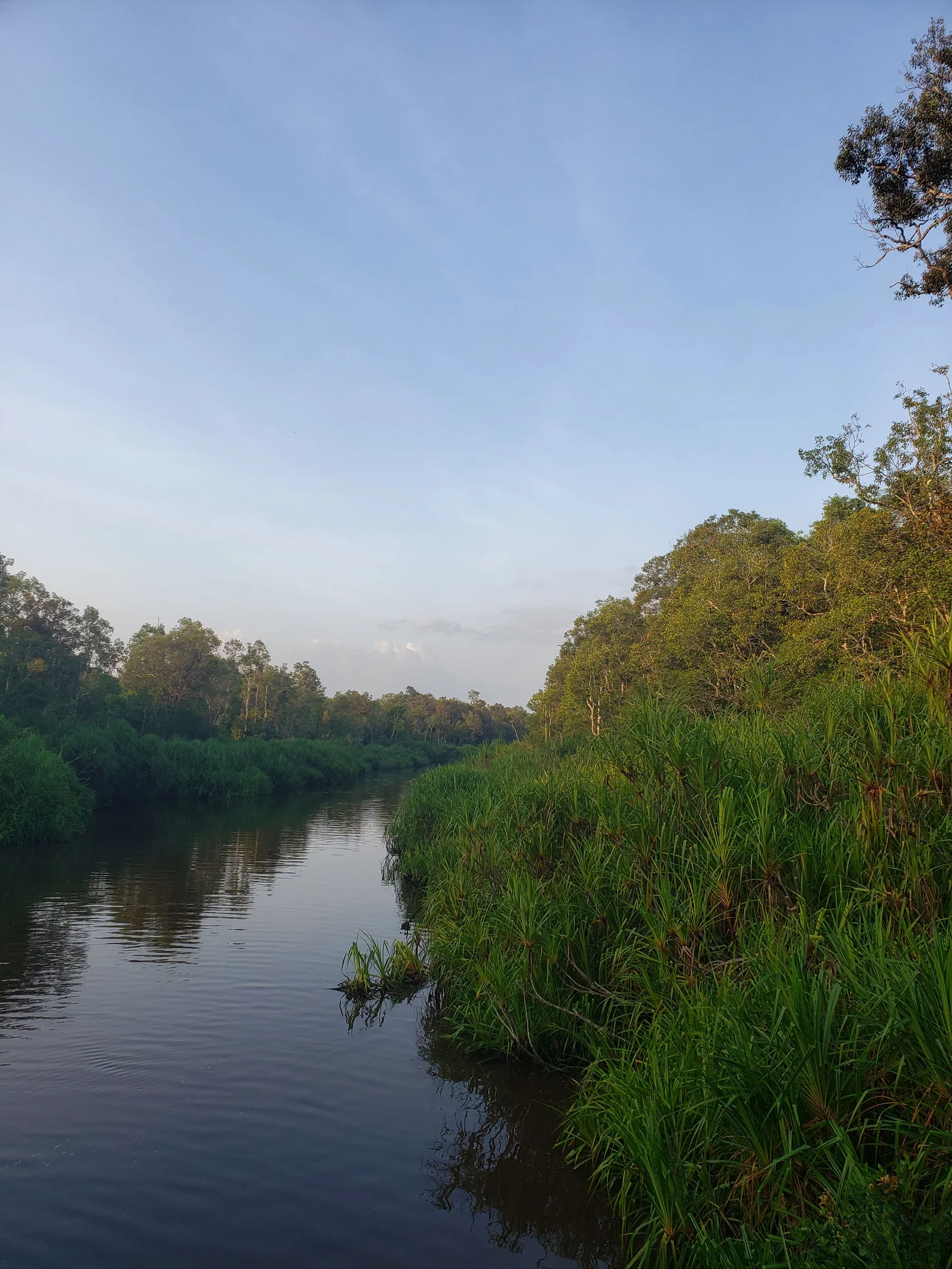
Decades of research on Borneo’s orangutans.
Tanjung Puting National Park and Camp Leakey lie within the range of the central Bornean orangutan, Pongo pygmaeus wurmbii.
Orangutans have been studied at Camp Leakey since the early 1970s. That long history has given researchers decades of observations of the same population, showing how individuals live, move and reproduce, and how the population has changed over time.
Go deeper.
For more on orangutan biology and behaviour, see Orangutan Facts. For a closer look at the pressures facing Bornean orangutans, explore Threats and Palm Oil.
- IUCN Red List: Bornean Orangutan (2016; errata 2018)
- Banes, Galdikas & Vigilant 2016: Bornean subspecies and geographic barriers
- Kanamori et al. 2010: Feeding ecology of Northeast Bornean orangutans
- Ancrenaz et al. 2014: Terrestrial activity in Bornean orangutans
- Orangutan Facts
- Threats to Orangutans
- Palm Oil and Orangutans
- Guide to Tanjung Puting
- Ethical Orangutan Tourism